
Oxygen Support at Home in Delhi NCR
Home oxygen is widely prescribed for COPD, pulmonary fibrosis, post-COVID recovery and palliative care, and it is widely used incorrectly. Flow rates get adjusted by well-meaning relatives, saturation goes unmonitored, and in some conditions too much oxygen is genuinely harmful rather than merely wasteful. Our professionals set up the concentrator or cylinder, set the flow rate the doctor prescribed, monitor oxygen saturation and the patient's response, and check the equipment is working as it should. They also cover the safety basics families routinely miss — no open flame near oxygen, correct humidifier use, cannula hygiene. Equipment is supplied by the family or a rental vendor; we provide the trained supervision that makes it safe.
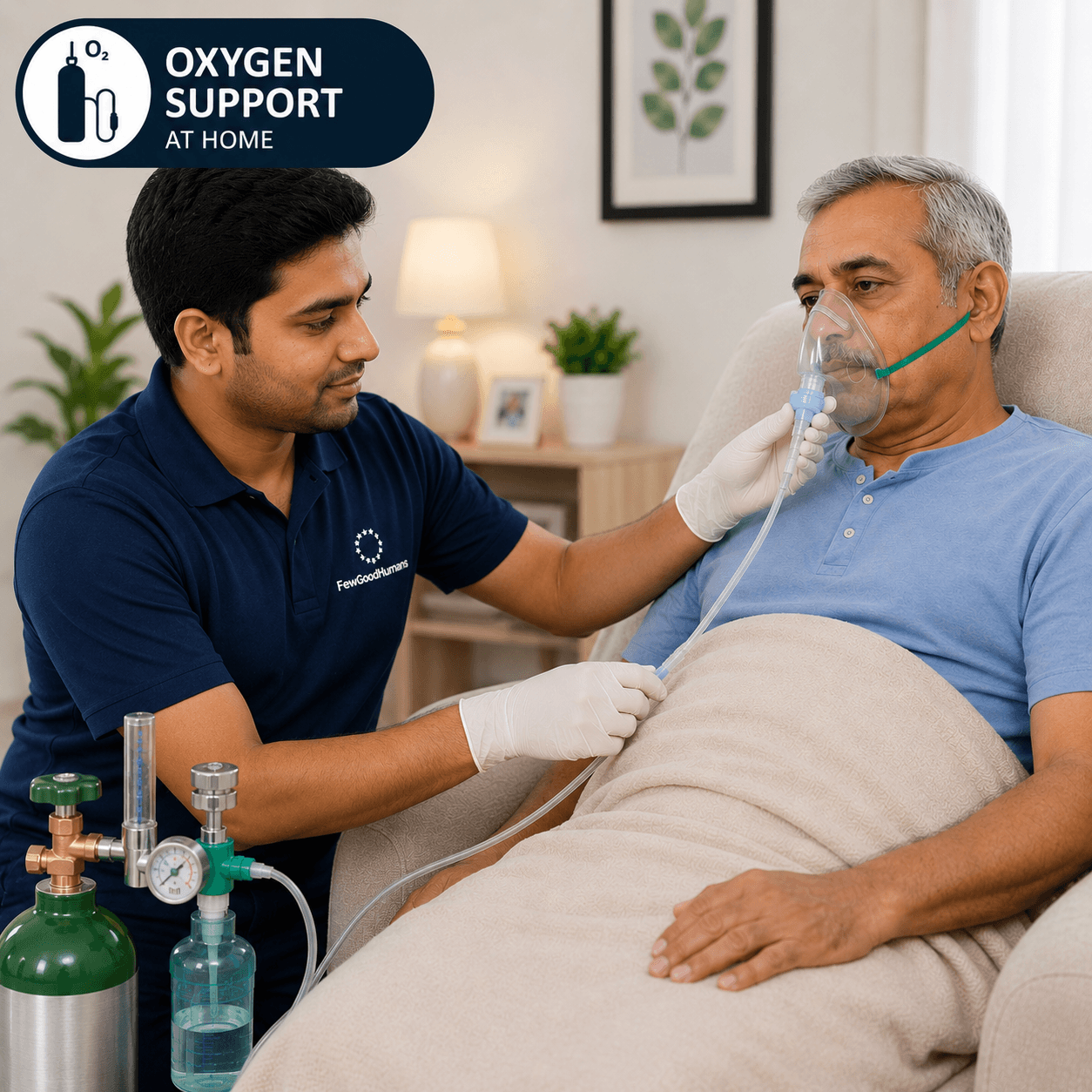
What's included
- Oxygen concentrator or cylinder setup
- Flow-rate setting to the prescribed level
- Continuous SpO2 and respiratory monitoring
- Nasal cannula or mask fitting and hygiene
- Equipment function check
- Oxygen safety briefing for the household
- Guidance on when to escalate to hospital
Who needs this service
- COPD and pulmonary fibrosis patients on home oxygen
- Post-COVID patients with persistent low saturation
- Palliative care patients needing comfort oxygen
- Patients discharged on prescribed oxygen therapy
- Elderly patients with chronic low oxygen saturation
Pricing
One published price. Everything listed on this page is included — nothing is added to the bill afterwards.
Frequently Asked Questions
Do you supply the oxygen concentrator or cylinder?
No. We provide trained staff to set up, manage and monitor oxygen therapy. The equipment is arranged by the family or a rental vendor — your hospital can usually recommend one.
How much does oxygen support at home cost?
Rs 899 per visit for setup and monitoring. For continuous oxygen-dependent patients, a 12 or 24-hour MQA shift is the more practical arrangement.
Can we adjust the oxygen flow rate ourselves?
Please do not, unless your doctor has explicitly told you how and when. In conditions such as COPD, excessive oxygen can suppress respiratory drive and cause real harm. Flow rate is a medical decision.
What SpO2 level is a cause for concern?
Thresholds depend on the underlying condition and your doctor should give you a target range. As a general rule, sustained saturation below 90 percent, or a sudden drop from the patient's normal baseline, warrants urgent medical attention.
Is home oxygen safe?
Yes, with correct handling. The main hazards are fire risk near open flame, incorrect flow rates and poor cannula hygiene. The professional briefs your household on all three at setup.
Related services
Care that reaches you at home.
Verified attendants, published pricing and complete digital paperwork. Book your first service today.